


Description
LNWR 1875 Precursor Class engine
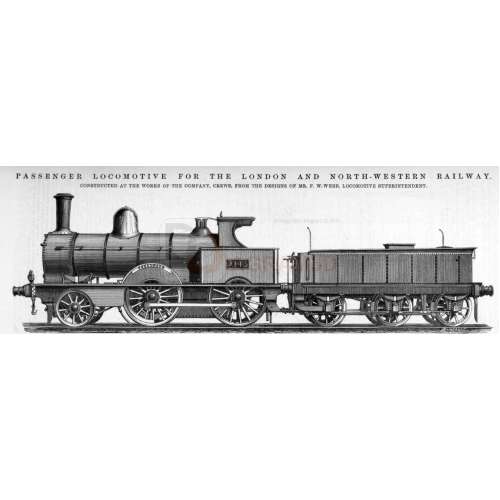
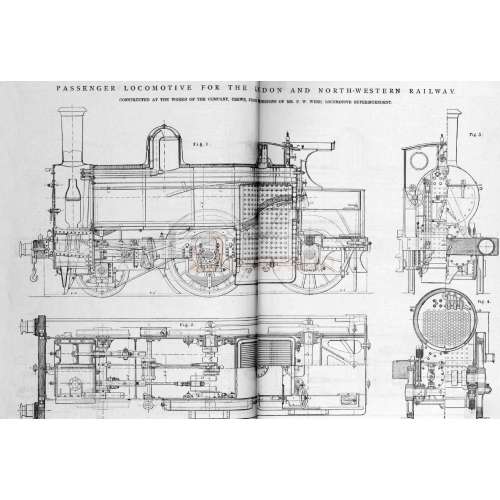
PASSENGER LOCOMOTIVE FOR THE LONDON AND NORTH-WESTERN RAILWAY.
CONSTRUCTED AT THE WORKS OF THE COMPANY, CREWE, FROM THE DESIGNS OF MR. F. W. WEBB, LOCOMOTIVE SUPERINTENDENT.
(Precursor Class 1875)
It will be remembered by many of our readers that when Mr. Robinson’s paper on “Modern Locomotives” was read before the Institution of Civil Engineers during the session of 1873-4, one of the chief points upon which the discussion turned was the difference between the types of locomotives employed on the Great Northern and London and North-Western railways respectively for working the express traffic. On the former line, although four-coupled engines are largely used, the class of express locomotive described by Mr. Robinson as the representative type, was that illustrated and described by us about four years ago ( page 140 of our eleventh volume).
This type, which has been designed by Mr. Stirling, the locomotive superintendent of the Great Northern line, has outside cylinders 18 in. in diameter and 28 in. stroke, and single driving wheels 8 ft. in diameter, while the front end of the engine is carried on a four-wheeled bogie.
On the London and North-Western Railway, on the other hand, although there are a number of express engines with single drivers at work, yet the representative types for fast passenger service are four-coupled engines. The class described by Mr. Robinson as a representative one has cylinders 17 in. in diameter with 24-in. stroke and four-coupled wheels 6 ft. 7 1/2 in diameter, these engines being, at the time when Mr. Robinson’s paper was read, used for working the Scotch expresses over the northern section of the London and North-Western line, while between Crewe and expresses over the northern section of the London and North-Western line, while between Crewe and London the trains were taken by locomotives of the well-known “ Bloomer” class with cylinders 16 in. in diameter and 22 in. stroke, and single drivers 7 ft. in diameter.
Since the date above referred to, however, Mr. F. W. Webb, the locomotive superintendent of the London and North-Western Railway has adopted a practice differing still more from that of Mr. Stirling, and he is now working the Scotch expresses on the northern section of his line with a four-coupled engine having wheels but 5 ft. 6 in. in diameter, while for working the southern section he is building engines exactly similar to those just mentioned, except that the diameter of the coupled wheels is increased to 6 ft. 6 in. The boilers, working gear, cylinders, &c., are exactly alike in the two classes of engines, the locomotives with the 6 ft. 6 in. wheels simply having the boilers lifted higher up, and the framing modified to accommodate the larger driving wheels, while retaining the same leading wheels and height of footplate as the engines for the northern division.
By the courtesy of Mr. Webb we are enabled this week to publish a two-page engraving of one of the four-coupled locomotives with 5 ft. 6 in. wheels, of which we have just spoken; and characterised as the engine is by many special features, we believe that it will be examined with much interest. We also give on the present page a general view of the engine and tender combined, which will convey a good idea of the great neatness and simplicity of the whole design.
Downloads
LNWR 1875 Precursor class engine (Size:2.19MB) Download
Information
Customer Service
 |